
Yesterday (March 12, 2020), the Government of Panama declared the country in a state of emergency due to the coronavirus pandemic. This could lead to economic problems, as has been seen in other countries, and even put some jobs at risk, adding to the situation in which the country’s economy found itself.
In one of the president’s messages, he made the following comment:
“I instruct all private companies and I instruct the Government to apply the new remote work law, to the extent possible to keep the greatest number of people at home.”
But what is remote work and what Law does it refer to? How can we help others get started in this “Remote Work” thing?
#.Remote Work
Remote Work (or Remote Work, Working from Home, as it can be known in English) is simply doing our work in a place other than the office, through the use of information and communication technologies.
For a more appropriate definition, the ILO defines Remote Work as “a form of work that is carried out in a location away from a central office or production facilities, separating the worker from personal contact with work colleagues who are in that office and how new technology makes this separation possible by facilitating communication”.
In Panama, the President of the Republic sanctioned on February 18, Law 126 of February 18, 2020, “Which establishes and regulates remote work in the Republic of Panama (…)”, which was introduced by independent lawmaker Raúl Fernández 👏👏.
Through this Law, it is sought that more entrepreneurs opt for this means of work for their collaborators, whether partially or completely.
For us in the technology industry this is already common. In my case, working for a company based in Santa Barbara, California, I haven’t had to go to an office for months and I can do it from anywhere in the world, without any problem.
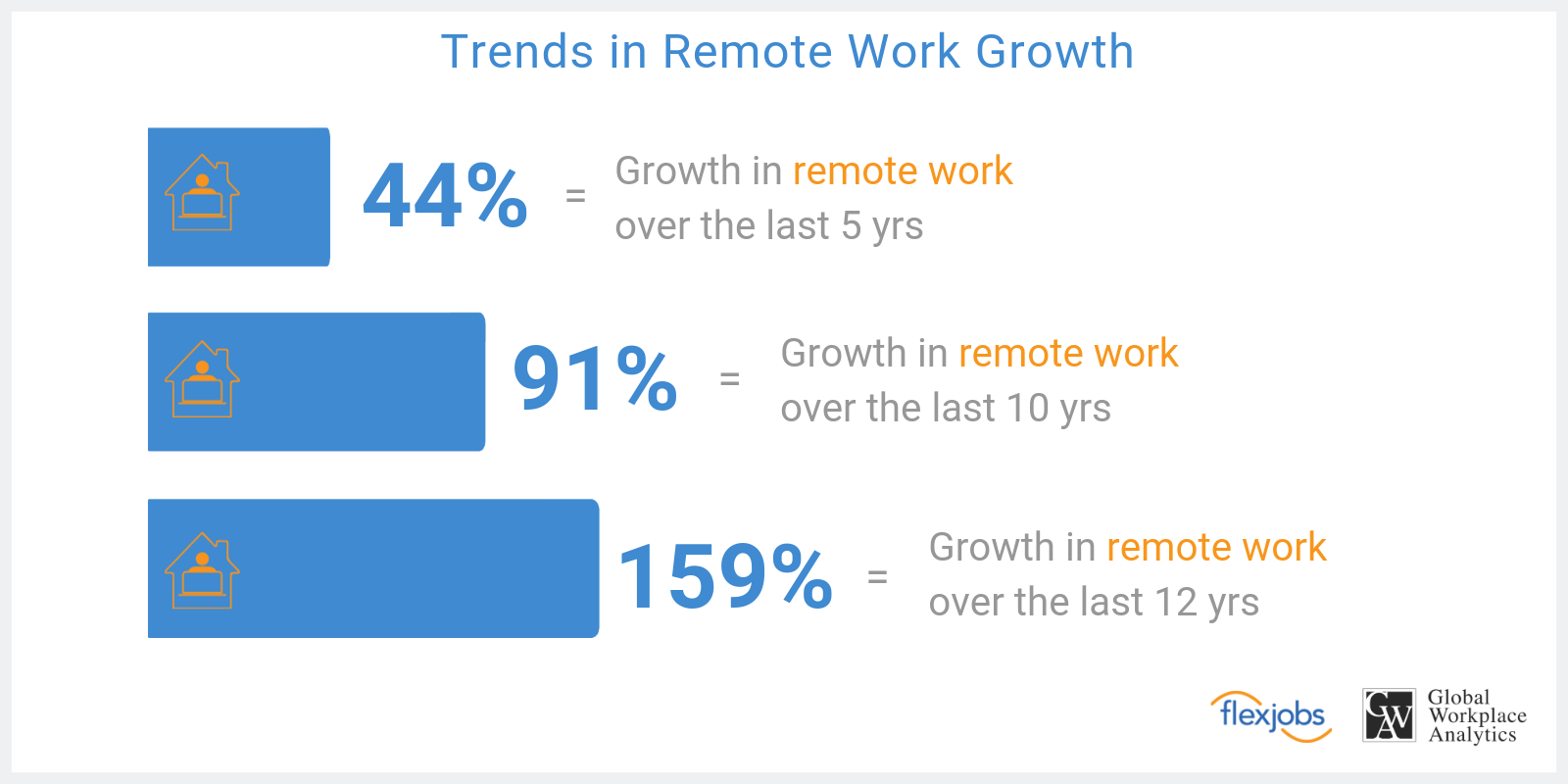
In the United States alone there was a 159% increase in people choosing to telework, as shown in figure 1.
#.1. Recommendations to implement Remote Work: The employer
I start by saying that, while it is true that Remote Work works for most people, it obviously does not work for everyone. There are jobs that require a physical presence and others that do not. For example, it is obvious that if the job is construction it cannot be performed remotely. For the rest that this works, I clarify that the recommendations I make are based on my own experience over several years.
#.1.1. Communication is everything
Just like a regular, physical environment: communication is everything. Being remote and without physical presence, communication is much more difficult to ensure, but not impossible.
Maintaining an online communication channel is extremely important, so you must ensure that all your collaborators have access to:
- Broadband Internet accessibility.
- Physical tools needed: a laptop (ideally), a webcam, a microphone, headphones.
- An email.
- An online messaging system. I recommend Slack, Discord or even Skype, Zoom, WhatsApp or Messenger (Facebook).
You decide the tools on your own, it is important that you understand that this is the essential part of Remote Work: staying connected.
The messaging system, in my opinion, is crucial. Through it we can send communications to all collaborators, interact almost instantly or receive feedback almost immediately.
Likewise, training on these topics is important, without leaving anyone behind.
#.1.2. Replace micromanagement with trust, transparency and inspection
One of the most important concerns of employers is: how do I know that my collaborators are working? Which makes many of them pour all their energy into just verifying that everyone is working as they should (micromanagement).
This is not going to work for you, your collaborators are going to get more stressed, they are not going to perform enough and you are not going to have the results you expect.
Replace it with giving them the confidence to carry out their work as they already know how to do it, having transparency in communication and review of previously established objectives and constant inspection of the achievements made.
#.1.3. Constantly check how your collaborators feel
Many employees may feel alone working in an environment without people around. Try to verify that everyone feels good and satisfied with this new process and do it constantly.
Instead of constantly seeing what they do, use that energy to constantly validate how your collaborators feel:
-
Are they more stressed or are they overworking?
-
Are you happy or sad now that you don’t have contact with people? Try to have short meetings in a row with your staff, they can even have events outside of the routine (and these events can be remote too). This is very normal in companies that carry out remote work for all their staff:
-
They use a specific space of the week to talk about a specific non-work topic: favorite movies, favorite books, what their last trip was… whatever.
-
They celebrate special days (Valentine’s Day, Halloween, among others) remotely.
Remember: the main thing is to remember that you work with people.
#.1.4. It’s a process, understand it as such
“My company nor my employees have a culture for this,” I have heard it several times and the truth is that without having tried it, it is just a hypothesis.
At first everything may not go as you expect and that’s okay. At constant intervals and with sufficient trust and the inspection and feedback of your collaborators, Remote Work will improve significantly.
Remember that it has been proven that remote work improves the productivity of your employees fn-1, the morale of your team fn-2 and 57% of collaborators who telework report that they have greater satisfaction with their employers fn-3.
It goes without saying the positive effects towards the result of your work.
#.2. Recommendations: Contributor
#.2.1. Communicate: there is no such thing as overcommunication in this case
You are starting an unusual way of working for many. Try to let everyone know when you start or stop working (just so they understand your availability). Try to keep everyone informed about your progress, your needs, your current blockages or impediments, among others.
The more you can communicate efficiently, the better.
By efficiently I mean not making “noise”:
- Send what is extremely necessary.
- That the message is through the appropriate channel.
- That the recipient of the message is only the one required.
- Keep the message as short and to the point as possible. Short emails are better than a book.
Likewise, and as I have already said above: a webcam, a good headset and microphone are extremely necessary and not at all expensive.
#.2.2. Maintain a routine: it’s not working in your pajamas
Remember it’s all about trust. If your work schedule is from 8am to 5pm, you must respect your schedule and behave like a professional.
Make a daily routine around your work, just as if you were going to an office. Believe me, working in your pajamas may sound fun, but the results are better if you try to maintain a work routine like you used to: get ready, have breakfast and coffee, go to work (to the designated space), etc...Likewise, try to maintain a routine for the rest: your meals, your breaks, your end time.
#.23. If possible, organize a space for it.
Invest in your workspace, in your remote office.
If you can convert a place in your house into a small office, do it. It will not only help you concentrate but also (mentally) separate when you are working from when you are resting.
In addition to this “mental programming” to know how to define when you work, you will indicate to the rest of your family that at the moment you are in this area you are working.
This space should have everything you need to work, just like the office: a good desk, a good chair, work supplies (paper, pens, pencils, etc…), water and some snack ideally.
Get away from other distractions such as TV or cell phone, just as you would in an office. The main idea is to stay focused and concentrated as much as you can.
#.2.4. You are working, remember
Schools are closed at the moment, so if you have children at home, make sure that they, and everyone who lives with you, understand that you are working and need a space (physically and temporally) without interruptions or distractions, like the dog:
Try to communicate to all the people who have any contact with you that while you are on a work schedule it means that you are working and require that they not interrupt you. They will understand and everything will be better.
#.2.4. Work-life balance: what does it mean?
It all sounds nice: not going to work, not seeing anyone, not spending money on gas or traffic. Wrong 👀.
Working remotely can also bring problems: feeling isolated, alone, disconnected from the world completely. If you feel this way, remember that it’s all about achieving a balance between your work life and your personal life and trying not to let one deprive the other.
Talking about this with others is not bad, keep that in mind.
#.3. Final comments
I have already mentioned the benefits, but if you still need to know why we should encourage Remote Work right now:- In this current crisis, it is easier to keep ourselves (and those around us) safe and out of danger.